Comparing Vienna, Graz, Linz, Salzburg and Innsbruck for founders and investors — practical guidance on corporate tax, local incentives and company formation.
Introduction
Choosing the best location to start a business is rarely about a single factor. Entrepreneurs weigh corporate tax, tax incentives, market access, workforce quality and the ease of company formation — and Austria’s cities offer distinct advantages depending on sector and growth strategy.
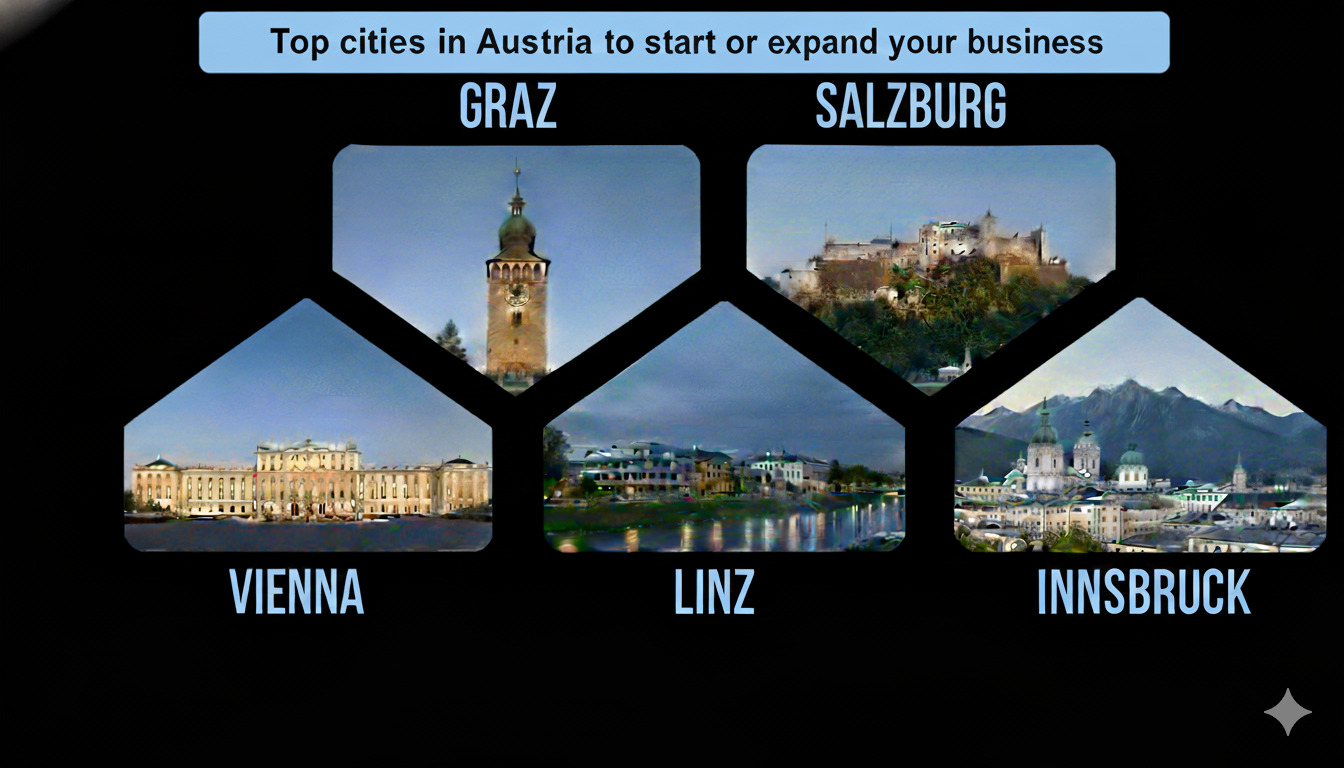
This article compares five carefully selected Austrian cities for 2025 — Vienna, Graz, Linz, Salzburg and Innsbruck — using a consistent city‑level methodology: headline corporate tax implications, municipal and regional incentives, company formation processes in Austria, visa/residency options for founders and the most promising local sectors for investment.
Austria’s diverse urban economy means some cities are excellent for finance and ICT, others for advanced manufacturing, tourism or alpine tech. While federal corporate tax rates are set nationally, local incentives, industry clusters and speed of formation vary by city — which can materially affect time to market and operating costs.
So, which of these Austrian cities is the right fit for your business plans in 2025?
Below we outline practical, up‑to‑date points you can act on: comparative corporate tax notes, typical company formation steps and timelines in Austria, available tax incentives and municipal supports, and visa or residency pathways for founders and investors. Use this as a decision framework — and if you want a tailored recommendation, there’s a quick checklist and a downloadable city comparison table later in the article.
List of Top 5 Austrian Cities for Business in 2025
1. Vienna
Vienna is Austria’s economic and financial hub, offering broad access to talent, finance and international markets. The city combines strong infrastructure, a dense services sector and established clusters in fintech, ICT and life sciences — making it an attractive location for businesses seeking scale, access to skilled labour and proximity to central European markets.
Key benefits
- Access to finance and talent: Major banks, venture funds and international firms are concentrated in Vienna, easing fundraising and partnerships for startups and companies.
- Excellent infrastructure: High‑quality transport, digital connectivity and logistics support B2B and export‑oriented businesses.
- R&D and innovation supports: National and municipal programmes (FFG, Vienna Wirtschaftsagentur) provide grants, R&D funding and incubator support.
- International workforce: Multilingual, highly skilled professionals and universities feeding talent into tech and life‑science sectors.
Challenges:
- Higher operating and office costs than many regional Austrian cities — wage levels and rents are above national averages.
- Competitive market: standing out requires strong value propositions or niche specialisation.
Best sectors to invest in
- Fintech and financial services
- ICT, SaaS and deep tech
- Biotech and health tech
- Professional services and consultancies
Quick stats: Austria applies a federal corporate tax rate (verify current corporate tax rate for 2025); company formation (GmbH/UG equivalent) is straightforward with online registries and notary steps — allow 1–3 weeks with proper documentation. Vienna offers municipal incentives and startup programmes; consult Vienna Wirtschaftsagentur for current grants and tax incentives.
2. Graz
Graz is Austria’s engineering and advanced manufacturing centre, with strong industrial clusters around automotive suppliers, automation and precision engineering. The city benefits from technical universities and applied research institutes that feed a highly skilled engineering workforce into local companies.
Key benefits
- Strong manufacturing ecosystem: Dense supplier networks and specialised SMEs reduce supply‑chain friction for production firms.
- Applied R&D links: Close ties between universities (Graz University of Technology) and industry enable collaborative innovation and access to skilled graduates.
- Cost‑competitive operations: Lower office and industrial rents than Vienna while maintaining high workforce quality.
Challenges:
- Smaller local consumer market — many businesses are export‑oriented or rely on European integration.
- Some specialised talent can be competitive to recruit away from larger hubs.
Best sectors to invest in
- Advanced manufacturing and automotive suppliers
- Automation, robotics and industrial tech
- Materials science and engineering
- Clean energy components
Quick stats: Company formation follows Austrian national processes (GmbH common); verify applicable municipal incentives from the Styrian government and Graz economic development agency. Formation times typically range from a few days for registration filings to 1–3 weeks including bank and notary steps.
3. Linz
Linz combines industrial heritage with a growing tech and logistics scene. The city is strategically positioned on the Danube corridor, supporting manufacturing, logistics and digital industry initiatives. Linz has invested in smart city and Industry 4.0 programmes, attracting companies in industrial tech and advanced services.
Key benefits
- Logistics and access: Excellent transport links by road, rail and river — beneficial for manufacturing and distribution.
- Industry‑tech focus: Local clusters in automation, software for industrial applications and digital manufacturing.
- Public supports: Regional development funds and Linz economic development programmes supporting investment and R&D.
Challenges:
- Smaller VC and corporate finance scene compared with Vienna — early‑stage funding may require national or cross‑border investors.
- Some specialised roles require relocation or targeted recruitment.
Best sectors to invest in
- Industrial software and automation
- Logistics and supply‑chain services
- Advanced manufacturing and electronics
- Smart city solutions and digital services
Quick stats: Linz offers regional incentives; company formation is under Austrian federal law — expect similar formation timelines to other cities (1–3 weeks typical). Check the Upper Austria Business Agency for specific grant programmes and incentive schemes.
4. Salzburg
Salzburg is best known for tourism, creative industries and a growing cluster of lifestyle and food‑tech businesses. The city’s cultural profile and international visitor base create opportunities for B2C brands, hospitality tech and high‑value creative services.
Key benefits
- Tourism and brand economy: High tourist volumes support hospitality, experiential retail and premium consumer brands.
- Creative and cultural sector: Strong creative industries and cultural events provide channels for marketing and product testing.
- Quality of life: Attractive living standards help recruit talent for customer‑facing and creative roles.
Challenges:
- Seasonality in tourism can affect cash flow for consumer businesses.
- Smaller industrial base for heavy manufacturing — supply chains may need to be regionalised.
Best sectors to invest in
- Tourism tech and hospitality services
- Food tech, agri‑food and premium consumer goods
- Creative industries, media and events tech
- Sustainable tourism and mobility solutions
Quick stats: Salzburg offers regional support schemes and incentives for tourism and creative projects; company formation follows Austrian federal rules — consult Salzburg Wirtschaftsservice for up‑to‑date funding and incentive information.
5. Innsbruck
Innsbruck specialises in alpine tech, sports innovation and medtech linked to mountain health and sports science. The city’s proximity to alpine testing grounds and research institutes gives it a niche advantage for companies building products for mountain environments and performance sports.
Key benefits
- Niche R&D strengths: Research centres and applied institutes focused on sports science, medtech and alpine technologies.
- Access to specialised test environments: Mountains and climate conditions ideal for product testing in real‑world conditions.
- Quality of life and talent attraction: High living standards and outdoor lifestyle help attract specialised engineers and researchers.
Challenges:
- Smaller domestic market and limited local corporate finance options — projects often target export markets or niche B2B customers.
- Operating costs can be higher due to location, particularly for logistics and specialised equipment.
Best sectors to invest in
- Sports tech and wearable devices
- Medtech and rehabilitation technologies
- Alpine and environmental technology
- Outdoor equipment and performance materials
Quick stats: Innsbruck benefits from Tyrol regional incentives and research supports; company formation is under Austrian federal company law — expect standard formation steps and timelines similar to other Austrian cities. Contact Tiroler Wirtschaftsförderung for local programmes and R&D grants.
How we selected these cities: We chose Vienna, Graz, Linz, Salzburg and Innsbruck for distinct city‑level value propositions — finance and scale (Vienna), advanced manufacturing and engineering (Graz, Linz), tourism and creative industries (Salzburg) and niche alpine R&D (Innsbruck). Our assessment weighed corporate tax implications, municipal and regional incentives, ease of company formation under Austrian law, quality of infrastructure and access to a highly skilled workforce.
For a concise comparison you can use immediately, download the one‑page city comparison table (corporate tax, average formation time, top incentives and recommended company form) or contact our advisors to get a tailored recommendation for your sector and budget.
What’s Special About Europe (and What It Means for Austrian Cities)
Europe offers scale, market access and sophisticated business ecosystems that few other regions can match. For founders choosing where to start a business in 2025, those advantages — large markets, strong infrastructure, targeted tax incentives and a highly skilled workforce — are accessible from Austrian cities while benefiting from Austria’s full participation in the European Single Market.
Access to a Large and Wealthy Market
Austria’s EU membership means businesses based in Vienna, Graz, Linz, Salzburg and Innsbruck can serve customers across the European Single Market with relative ease. Registering for EU VAT, understanding cross‑border services rules and leveraging EU distribution channels are essential steps for companies that plan to scale beyond Austria.
Strong Infrastructure & Digital Economy
Austrian cities score well on transport, digital readiness and logistics. Vienna’s international connections and ICT infrastructure support finance and SaaS firms; Linz’s Danube corridor strengthens logistics and manufacturing; Graz links industry with applied research. These infrastructure strengths reduce friction for tech companies, exporters and companies relying on advanced supply chains.
Attractive Tax Policies & Local Incentives
While headline corporate tax is set at the federal level in Austria (verify the current corporate tax rate for 2025), local and regional incentives matter. Cities and Bundesländer offer targeted tax incentives, grants and programmes for R&D and investment — for example federal supports via FFG and regional programmes from Vienna Wirtschaftsagentur, Styrian authorities, Upper Austria Business Agency, Salzburg Wirtschaftsservice and Tiroler Wirtschaftsförderung. Investigate tax incentives and local grant programmes early in site selection.
Highly Skilled and Multilingual Workforce
Austrian cities supply a highly skilled, multilingual workforce — strong vocational training and technical universities feed talent into local clusters. Vienna and Graz are particular hubs for ICT and engineering talent, while Salzburg and Innsbruck supply strong service, hospitality and specialised research skills for tourism and alpine technology sectors.
Business‑Friendly Systems & Company Formation Processes
Many European countries have modern, digital company registries; Austria offers a clear, consistent federal company formation system (GmbH and other common forms). City and regional agencies can accelerate permits, offer guidance on formation processes and point to tax incentives — use these local supports to shorten time to market and simplify processes for setting up companies and hiring.
Practical takeaways for founders
- Set up EU VAT if you plan to sell across the Single Market and check cross‑border VAT rules early.
- Investigate national and regional R&D incentives (FFG, AWS and city programmes) if your business is innovation‑intensive.
- Consider Vienna for access to finance and talent; Graz and Linz for industrial and engineering clusters; Salzburg for tourism and consumer brands; Innsbruck for alpine, sports and medtech innovation.
- Non‑EU founders should review Austria’s Red‑White‑Red Card and residency pathways — consult immigration specialists for up‑to‑date processes.
For a side‑by‑side view of corporate tax, key incentives, company formation times and visa/residency options for Vienna, Graz, Linz, Salzburg and Innsbruck, jump to the city comparison table below or download the one‑page summary to compare locations quickly.
Which City Should You Choose?
The best city to start a business in 2025 depends on your sector, priorities and growth strategy. Below is a concise one‑line summary of the five Austrian cities covered so you can match purpose to place.
- Vienna: Access to finance, international talent and scale — ideal for fintech, ICT, biotech and service‑led companies seeking investors and a strong business environment.
- Graz: Advanced manufacturing and engineering clusters with strong R&D links — suited to industrial tech, automation and high‑precision suppliers.
- Linz: Logistics and Industry 4.0 focus on the Danube corridor — a good location for industrial software, electronics and supply‑chain businesses.
- Salzburg: Tourism, creative industries and premium consumer brands — best for hospitality tech, food‑tech and lifestyle businesses that benefit from high tourist footfall.
- Innsbruck: Niche alpine and sports innovation with specialised research — top for sports tech, medtech and environmental or mountain‑focused solutions.
Quick decision checklist:
- If you need access to capital, international talent and a big market → consider Vienna.
- If you prioritise industrial clusters and applied R&D for manufacturing → consider Graz or Linz.
- If your business relies on tourism, events or premium consumer experiences → consider Salzburg.
- If you develop niche tech for alpine, sports or medtech applications → consider Innsbruck.
Next steps: download the one‑page city comparison (corporate tax implications, formation time, top incentives and residency routes) or Speak to an advisorfor a tailored recommendation based on your sector and investment plans. Non‑EU founders should review Austria’s Red‑White‑Red Card and residency pathways early in planning — our advisors can connect you with immigration specialists and local contacts for each city.